
On 12 March, at the initiative and with the active engagement of Prof. Marek Konarzewski, President of the Polish Academy of Sciences, a demonstration was held at the Kezo Research Center in Jabłonna to showcase recent advances in aerostat technology developed by scientists from the Institute of Fundamental Technological Research of the Polish Academy of Sciences (IPPT PAN) in collaboration with industry partners. The meeting served to present the concept of an aerostat equipped with a suite of sensors enabling multi-aspect airspace monitoring.
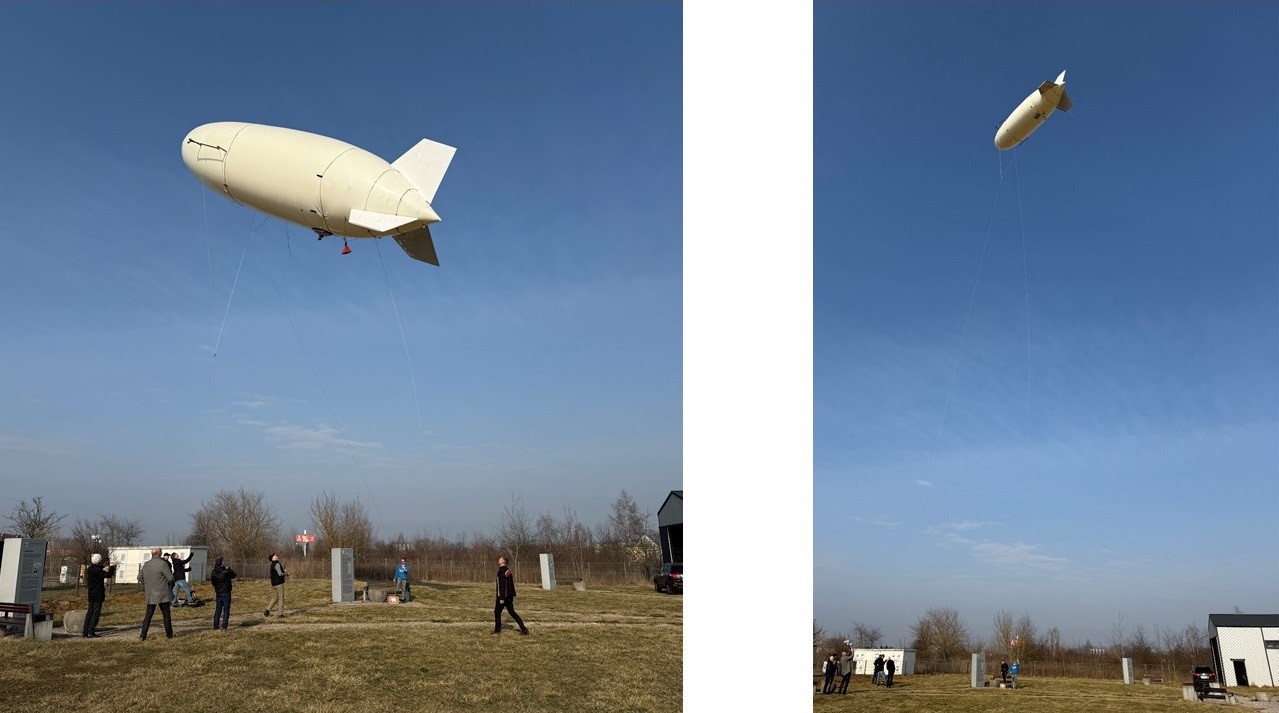
On 12 March, at the initiative and with the active engagement of Prof. Marek Konarzewski, President of the Polish Academy of Sciences, a demonstration was held at the Kezo Research Center in Jabłonna to showcase recent advances in aerostat technology developed by scientists from the Institute of Fundamental Technological Research of the Polish Academy of Sciences (IPPT PAN) in collaboration with industry partners. The meeting served to present the concept of an aerostat equipped with a suite of sensors enabling multi-aspect airspace monitoring.
The project development was driven by a growing demand for effective yet relatively inexpensive airspace observation and surveillance solutions. The flying platform was designed at the Department of Intelligent Technologies of IPPT PAN under the leadership of Prof. Jan Holnicki-Szulc and Dr. hab. Eng. Zbigniew Wołejsza, in collaboration with Adaptronica Sp. z o. o., a company affiliated with IPPT PAN. The surveillance system was developed by XY Sensing – a technology company originating from the Warsaw University of Technology – as part of a project led by Prof. Krzysztof Kulpa.
Participants in the meeting included Dr. Marcin Kulasek, Minister of Science and Higher Education, Stanisław Wziątek, Deputy Minister of National Defence, generals and representatives of the armed forces, Prof. Marek Konarzewski, President of the Polish Academy of Sciences, Prof. Natalia Sobczak, Vice-President of PAS, and members of the IPPT PAN Directorate. The demonstration was the first presentation of the developed aerostat platform to such a broad audience.
The flying platform, the tethered aerostat, currently has a payload capacity of approximately 10 kilograms (22 lb) for research equipment in calm, windless conditions. As wind speed increases, lift force rises proportionally to the square of the airflow velocity around the aerostat. The structure has been designed with scalability in mind, enabling future increases in payload capacity. This flexibility allows for the integration of various surveillance systems, including thermal imaging cameras and radio sensors. Preliminary estimates indicate that the total mass of all the aforementioned sensors, together with their power systems, should not exceed 70 kg (approximately 155 lb).
The system, provisionally named the Passive Aerostat Information and Analytical System, combines an aerostat platform integrating multiple detection technologies. The platform can accommodate optical and acoustic sensors, as well as a passive radar system exploiting so-called illuminators of opportunity (e.g. television, radio, and cellular transmissions). Signals reflected from airborne objects can then be received and processed, enabling the detection of drones and other aerial vehicles without the need to emit an active radar signal.
The detection suite also includes an ADS-B sensor enabling the identification of civilian aircraft equipped with aviation transponders. This capability allows for the rapid and effective discrimination between legitimate air traffic and potentially hostile or unauthorised targets. An additional layer of sensing technology consists of optical and thermal imaging systems, enabling the tracking and identification of objects even under adverse environmental conditions.
The aerostat platform’s key competitive advantage lies in its operational ceiling, at which sensors can be deployed. Elevating the system to several hundred meters above ground level substantially extends the surveillance range and enables the detection of objects beyond the horizon that would otherwise remain invisible to ground-based systems. At sufficient altitude, the platform can support airspace monitoring over ranges of several tens of kilometers.
Another crucial element of the proposed platform is its communication infrastructure, developed and implemented at IPPT PAN. Data from the aerostat is transmitted to the ground via a fiber-optic link integrated into the tether, ensuring high data throughput and secure communications. Additionally, a proprietary tether anchoring and platform stabilization system has been developed at the Institute for this project.
The demonstration highlighted the capabilities of the optical surveillance systems, including their ability to detect and track targets over ranges of several tens of kilometers. Actual detection performance, however, depends on multiple factors, including target size, speed, and environmental conditions.
The project also includes the development of data fusion and object classification algorithms that integrate inputs from multiple sensors into a unified situational awareness picture. This approach reduces false alarms and improves overall detection performance.
Although the primary recipients of this technology are likely to be institutions responsible for state security, its potential applications are much broader. The aerostat can support the operations of border services, the police, and organizations tasked with protecting critical infrastructure, securing airports and railways, and monitoring large-scale events.
The demonstration in Jabłonna showcased the strengths of the Polish scientific and technological expertise and served as an excellent example of collaboration between the scientific community and industry. Work at IPPT PAN is ongoing to further develop the full prototype of the technology, which remains feasible even within a short timeframe.
Other press articles: Polska Akademia Nauk / Portal WP tech
The aerostat’s design has been developed over the past five years, funded by the National Centre for Research and Development (NCBR), as part of joint projects with the National Science Centre (NCN) – “TANGO 2” and “TANGO 4” – whose main aim is to bridge the gap between fundamental research and development and its development and market implementation. The structural designs are based on patents granted to IPPT PAN by the Polish Patent Office. The first video showcasing the aerostat was published in 2021 on the IPPT PAN YouTube channel.

PHOTO REPORT FROM THE EVENT ON MARCH 12, 2026