
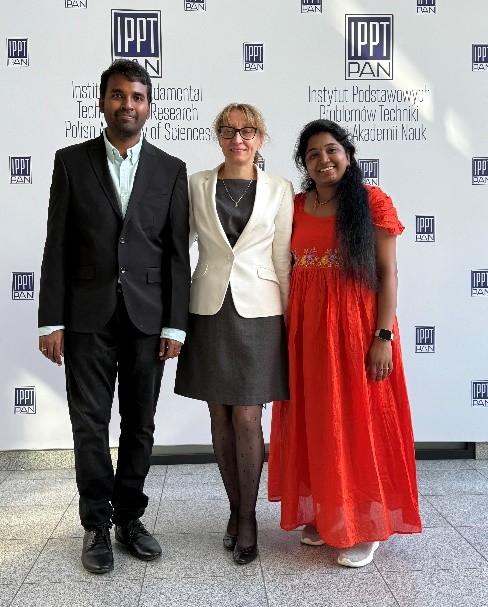
Dr Saketh Virupakshi from the Department of Mechanics of Materials at IPPT PAN has won the national stage of the prestigious ECCOMAS PhD Awards 2025, organized by the European Community on Computational Methods in Applied Sciences (ECCOMAS). This award is given for outstanding doctoral dissertations in the field of computational methods in applied sciences and engineering.
ECCOMAS is a European scientific organization comprising 23 associations focused on the advancement of computational methods in applied sciences and engineering. Each year, it presents two awards for the best doctoral theses defended across member countries.
Dr Saketh Virupakshiski, the winner of the national stage organized by the Polish Association for Computational Mechanics (PTMKM), will represent Poland in the European final, competing with top dissertations from across Europe.
ECCOMAS to europejska organizacja naukowa zrzeszająca 23 stowarzyszenia rozwijające metody obliczeniowe w naukach stosowanych i inżynierii. Organizacja ta w prestiżowym konkursie przyznaje dwie nagrody za najlepsze rozprawy doktorskie roku.
Dr Eng. Saketh Virupakshi, the winner of the Polish national stage organized by PTMKM, will represent Poland in the final, competing with the best works from across Europe.
He is a mechanical engineer and researcher specializing in computational mechanics, with a particular focus on the micromechanical modelling of materials in the inelastic regime. He completed his Bachelor of Technology in Mechanical Engineering at SASTRA University, India, graduating with distinction, and subsequently worked as a Design Engineer at Larsen & Toubro Limited, where he focused on mechanical equipment design for steel plants.
He then pursued his Master of Engineering at Hochschule Esslingen, Germany. During his studies, he completed his master’s thesis at Robert Bosch GmbH and later worked as a Mechanical Engineer at Isatec Engineering GmbH in Aachen.
In 2019, he began his Ph.D. at the Institute of Fundamental Technological Research (IPPT PAN), Polish Academy of Sciences, which he completed with distinction in September 2025. His doctoral research, supervised by Prof. Katarzyna Kowalczyk-Gajewska, focused on the micromechanical modelling of porous FCC and HCP polycrystals in the inelastic regime.
Since November 2025, he has been working at the Institute of Fundamental Technological Research (IPPT PAN), in the Department of Mechanics of Materials. His research focuses on the development of micromechanical mean-field models for porous polycrystals and the implementation of advanced user-defined elements for crystal-plasticity finite element simulations, aiming to capture the relationship between microstructural features—such as anisotropy, texture, and porosity—and the resulting macroscopic mechanical response.
His scientific interests include the modelling of thermodynamically consistent generalized continua, the development of deep-learning-based surrogate models to accelerate multiscale simulations, and variational homogenization approaches enabling accurate and efficient prediction of effective material behaviour.
Title of the award-winning dissertation:Micromechanical modelling of voided FCC and HCP polycrystals in inelastic regime.
In his dissertation, numerical analyses and a micromechanical approach were employed to unravel the mechanisms governing the ductile failure and its impact on the macroscopic response of porous single and polycrystals with FCC and HCP lattice symmetries. In the performed analyses relevant deformation mechanisms at the local level were considered, and appropriate micro-macro transition schemes were applied. A rate-dependent crystal plasticity constitutive model was employed, incorporating slip and twin mechanisms. In the model the evolution of the critical resolved shear stress (CRSS), influenced by the interaction between various slip and twin systems, and crystal reorientation scheme due to twinning were accounted for. Detailed results from numerical simulations on single and polycrystal unit cell models, conducted using the crystal plasticity finite element method (CPFEM), are presented, analyzing how plastic anisotropy, stress state, and boundary conditions affect void growth, coalescence, and collapse in porous FCC and HCP single and polycrystals.
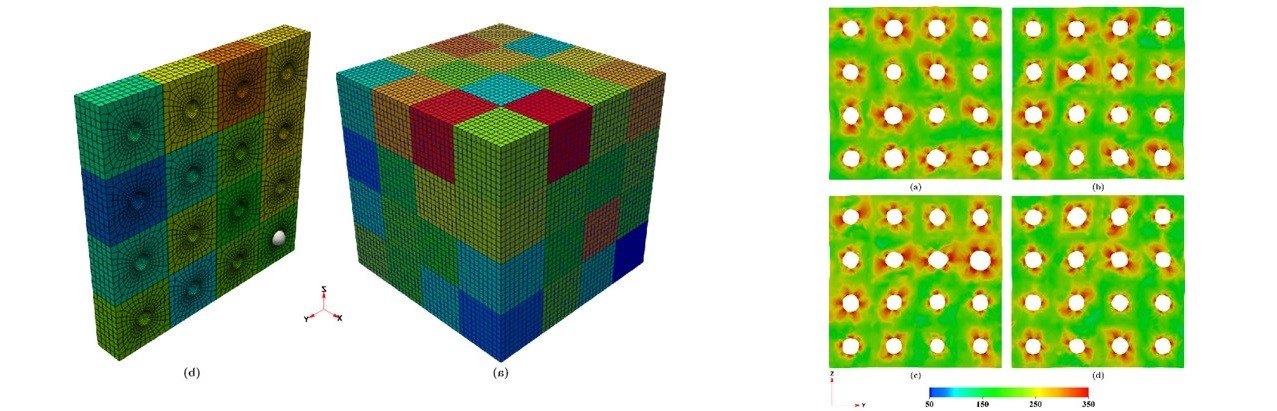
The work also explores the possibility of describing the macroscopic responses of porous crystals and polycrystals through micromechanical mean field models. The formulated mean field model uses the additive Mori-Tanaka scheme for porous single crystals and a three-scale model based on the additive self-consistent scheme for porous polycrystals. They are both validated against full-field numerical analyses. Additionally, using the proposed micromechanical model, a Gurson-Tvergaard-Needleman-like yield criterion for porous crystals was formulated, and its predictions were compared with existing models and validated with respect to numerical unit cell results. This newly proposed yield condition is well suited for the implementation into the finite element framework, following similar implementations by Ling et al. (2016) to predict damage in porous crystals. The results demonstrate that the numerical analyses and micromechanical approach are effective tools for understanding the relation between material microstructure, including the crystal lattice symmetry, and the developed scenarios of void growth and related changes in macroscopic response of metallic materials.